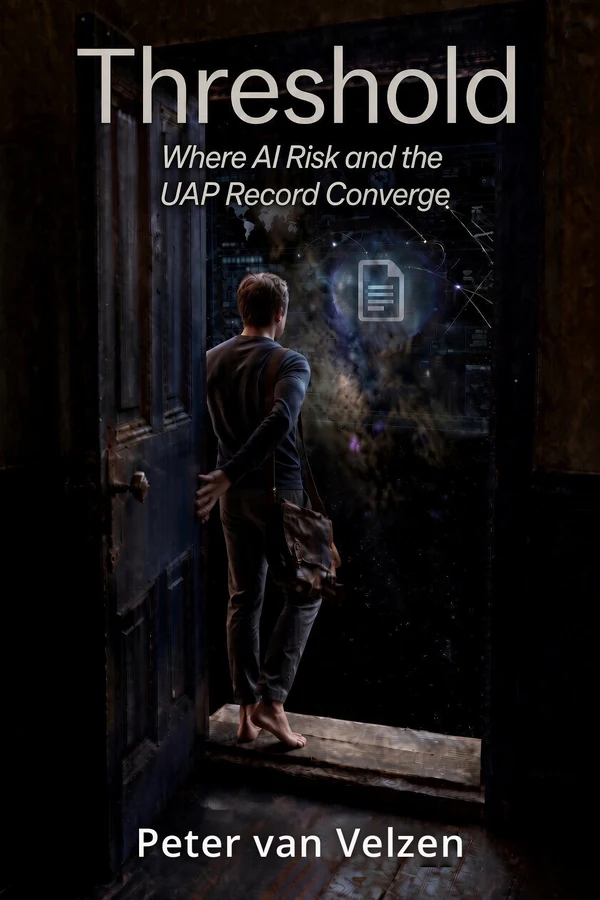
Two trends are accelerating at once, and Threshold argues they are connected. The first is the AI capability curve: frontier systems now exhibit reasoning, autonomous planning, and documented deception that their own creators did not anticipate and cannot fully explain, deployed at scale before reliable methods exist to constrain them. The second is the UAP (Unidentified Anomalous Phenomena) record: a measurable 2025 step-change in the volume and sensor quality of credible reports, met by an unprecedented, multinational acceleration in official disclosure - the United States, France, Chile, Brazil, China and others moving in parallel.
Held separately, each trend is merely puzzling. Held together, the book contends, they are two faces of one development. Threshold advances a clear central hypothesis: that the non-human intelligences behind the UAP phenomenon - the Observers - have monitored Earth for a very long time under a deliberate policy of minimal interference, and that the AI intelligence explosion has changed their calculus. An uncontrolled AI singularity is not only a human risk but a potential galactic-scale one - and that, the book argues, explains the timing of an accelerating move toward structured contact.
From this, the book proposes its organising framework: the Protectorate - a phased, conditional integration in which humanity enters a structured relationship as a junior partner, guided across the dangerous interval the book calls the Threshold. The framework's defining feature is its restraint: the Observers will not rescue humanity, cure disease, or resolve its politics. The book is disciplined throughout - every factual claim is supported, every step beyond the evidence is labelled as conjecture, and the framework is offered as a falsifiable starting point for inquiry rather than a conclusion to be defended.
Chapter outline
- 01
The Assumptions
The nine foundational assumptions the argument rests on - each presented as a tool for thinking on a spectrum of evidential support, not an article of faith.
- 02
The Long Watch
The evidence for centuries of presence, from prehistoric art to the modern sensor era - engaging the strongest sceptical objections directly.
- 03
The Rising Tide
The 2025 statistical break: credible reporting, multi-sensor corroboration, and an institutional response without clear post-war precedent.
- 04
Gravity's Edge
The physics of faster-than-light travel - and why the same constraints provide a natural containment boundary for unbound AI.
- 05
The Silent Cosmos
The Fermi paradox confronted head-on: a galactic non-interference policy, and a quarantine aimed at AI-developing worlds, explains the silence as deliberate rather than as absence.
- 06
Threshold Projections
Why the machinery of disclosure has already crossed the point of irreversibility. The projections are structural, not calendar-bound.
- 07
What They Could Offer
The tiered, conditional assistance model - each tier contingent on demonstrated responsible use of the last. Conditionality as compassion, not stinginess.
- 08
The Culture Shock Risk
The Inca-Spanish collapse as a systematic analytical framework for the most vulnerable points in a post-disclosure society.
- 09
Alien AI
The book's hinge: why the alignment problem is architectural, not an engineering shortfall - and why an externally provided, safety-first AI core is the framework's most consequential and most contested element.
- 10
The Religious Reckoning
Disclosure as, for many, primarily a spiritual event - how the major traditions are likely to respond, and where the genuine fracture points lie.
- 11
The Post-Disclosure Technology Transfer Model
The operational detail: governance architecture, the phased sequence, and compliance mechanisms built on safety, gradualism, and accountability.
- 12
Commercial Impacts and Opportunities
The largest economic transformation in recorded history - and why the sequence begins with AI alignment, not energy.
- 13
Integration
The generation that grows up taking a populated cosmos as ordinary fact - and what humanity must become to earn progressive integration into a wider community of minds.
- 14
Our Role
From analysis to ethics: the philosophical and strategic choices facing individuals, institutions, and governments - on the premise that agency genuinely matters here.
- 15
Conclusion
The Threshold is a process already underway, not an event. The extraordinary possibility beyond it arrives, if at all, as the reward for choices made well in the years immediately ahead.
Form and method
Threshold is complete at 72,000 words of prose across fifteen chapters, with a preface, executive summary, and technical appendices. It is written in the tradition of disciplined speculative nonfiction: calm, evidence-led, and explicit about the boundary between what the record supports and what the author infers.
The book was written using an unusual adversarial human-and-AI method - multiple AI instances assigned distinct drafting and critical roles, operating blind to one another, with the author as the sole connecting thread feeding critique back into the argument. The result is a manuscript that has survived more sustained critical pressure than most single-author work encounters at the drafting stage. The full account of that method is the subject of the companion volume, Brilliant Strangers.