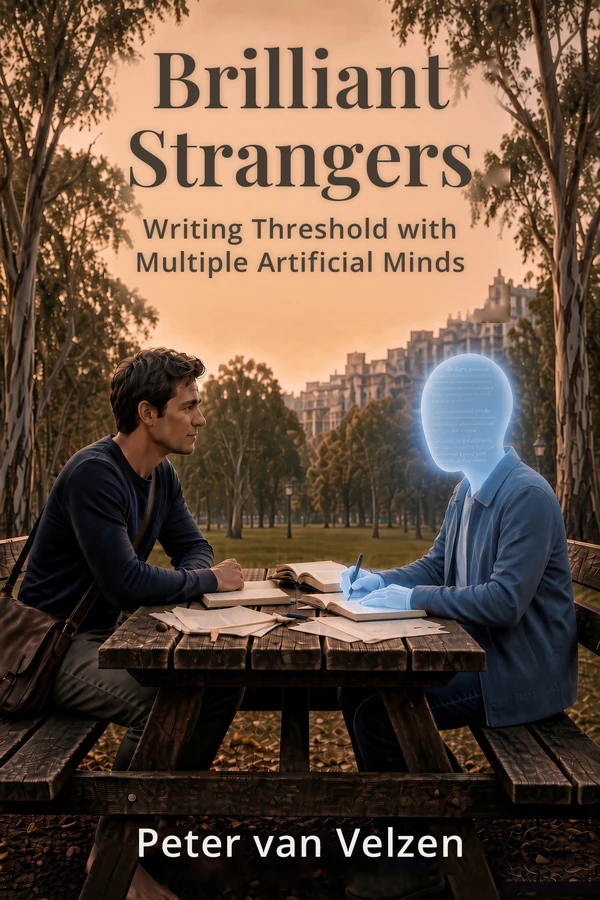
Brilliant Strangers is the methodology memoir: a first-hand documentary record of a human and artificial minds writing books together. It captures the genesis of Threshold and stands as a primary source on early multi-AI collaboration under human direction - what the work revealed about the machines, and what it revealed about the author.
Synopsis
Past the hype and the fear, Brilliant Strangers is an insider's record of writing long-form, complex literature alongside frontier AI systems - the architecture that governed multiple AI models, Claude, ChatGPT and Grok, before any dedicated enterprise tooling for this existed.
Its central thesis is honest topography: AI models are neither sovereign minds nor simple tools. They're brilliant strangers, rebooted fresh with every new chat, with real and repeatable failure modes - looping, over-eager closure, confident absence, the performance of an action without its substance. The book doesn't paper over these signatures. It maps them, and shows how blind multi-agent debate, forced pushback, and adversarial verification turn raw machine variance into a genuine search for truth - with the human author as the one continuous thread across every session, holding intent and carrying full responsibility for every word that survives.
The book is built the same way its subject demands: distinct roles assigned deliberately, one lane building an argument while another attacks it with everything available, neither permitted to see the other's private reasoning before delivering a verdict. Readers get the actual working, not a tidied retrospective - the arguments that survived contact with a genuinely adversarial second mind, and the ones that didn't, including a full account of where the process itself went wrong and had to be corrected mid-stream.
It captures the genesis of Threshold from the inside, and stands as one of the first primary-source records of what sustained, structured multi-AI collaboration under human direction actually looks like - written for anyone who has to decide, right now, how much of their own serious work to hand to a system they can't fully see inside.